Evaporator Fan Motor: What It Does and What to Check
What the evaporator fan motor does in a refrigerator or freezer, where it sits, how it differs from the condenser fan motor, which motor types are used and which details identify a replacement.
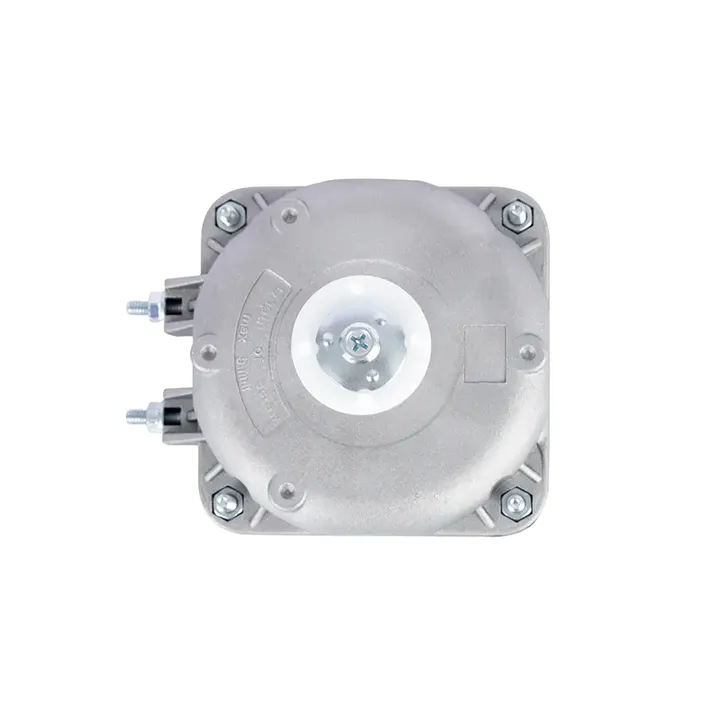
The Evaporator Fan Motor in Brief
The evaporator fan motor drives the small fan that moves air across the evaporator coil of a refrigerator, freezer or refrigerated cabinet. The coil absorbs heat from that air, and the fan then carries the cooled air through the storage space, so the temperature in the cabinet depends on the fan running whenever the compressor runs. The motor is usually a small single-phase machine mounted inside the cold space, behind a panel or a grille near the coil.
What an Evaporator Fan Motor Does
Air in the cabinet gives up its heat only where it touches the cold surface of the coil. If the air were left perfectly still, the layer in contact with the metal would cool quickly while the rest of the cabinet stayed warm. The fan prevents this by keeping the air moving, so that warm air is continuously brought to the coil and cooled air is carried away to the storage space. The fan therefore has two related jobs: it keeps the heat transfer through the coil high, and it keeps the temperature even throughout the cabinet, which matters most for food stored near the door.
The evaporator fan runs during cooling. In most domestic refrigerators and freezers it is switched together with the compressor, so it stops when the temperature is reached and the thermostat opens the circuit, and starts again when cooling resumes. This arrangement keeps the motor from running when it is not needed and avoids the fan warming the cabinet during the off cycle. In many commercial refrigerated cabinets the fan runs continuously while the cabinet is in service.
Where the evaporator fan sits in a refrigerator
In a domestic refrigerator with a single evaporator, the coil and its fan are normally placed in the freezer compartment, behind the rear panel. The fan draws air from the freezer, and the air passes over the coil and then either back into the freezer or, through the ducting, to the fresh-food compartment. In such appliances there is usually one fan, mounted on a bracket at the rear of the freezer, and its motor sits entirely in the cold air stream.
Commercial cabinets such as display cases, bottle coolers, prep counters and cold rooms use the same principle on a larger scale, and they may have several fans along a coil. Their motors are usually mounted on a bracket or rail beside the coil, and air from the storage space is drawn through the coil by the fan.
Evaporator and Condenser Fan Motors Compared
The condenser fan works on the warm side of the refrigerating circuit, outside the cabinet. Its motor is mounted on a bracket or a frame beside the condenser, where it is exposed to the heat of the compressor compartment and of the room air. Its duty is to remove heat from the condenser, and it runs whenever the compressor runs. The evaporator fan works on the cold side, inside the insulated space, in a stream of cold and often humid air. The evaporator fan motor must therefore cope with low temperature and moisture, while the condenser fan motor must cope with heat and dust. The two motors often look alike and can have similar ratings, but the airflow, blade and mounting of each are set for its own coil, so one is not simply swapped for the other.
Evaporator fan motors in freezers
In a freezer the evaporator fan motor works in the coldest part of the appliance, and moisture from the stored food and from door openings collects on the coil as frost. The motor must keep running in an air stream that is far below freezing and that is loaded with moisture each time the door is open, and it must tolerate the frost that forms on the fan blades and on the panel around it. Frost build-up on the blades makes them heavier and less regular in shape, which increases load and vibration and can eventually stop the fan. During each defrost cycle the coil warms and the frost melts, and afterwards the cold returns, so the motor has to withstand the repeated change from deep cold to melting ice and back. Air from the fresh-food compartment is relatively warm and moist, and it condenses or freezes on the coil and on the fan when it reaches the cold side, so the motor’s environment is more humid than the air temperature alone would suggest.
Motor Types Used for Evaporator Fans
Two kinds of small single-phase motor are commonly met with in evaporator fans: the shaded-pole motor and the permanent-split capacitor motor.
The shaded-pole motor is the simplest kind of alternating-current motor. Its stator carries a coil on salient poles, and a part of each pole face is enclosed by a short-circuited copper ring or turn, the shading coil, which causes the flux in that part of the pole to lag behind the rest. The result is a moving field, weak but sufficient to start the rotor and carry it round. Its efficiency is low and its speed falls as the load increases. These drawbacks are accepted in small evaporator fans because the motor is inexpensive, needs no capacitor or switch, and suits a fan that runs for long hours at a light, steady load.
The permanent-split capacitor motor has an auxiliary winding that is connected permanently in series with a capacitor, and it runs as a two-phase machine. It runs at a more nearly constant speed than the shaded-pole motor, at the cost of the added capacitor.
What Happens When the Evaporator Fan Stops
When the evaporator fan stops, the compressor may still run and the coil may still be cold, but the cold air no longer reaches the food. The temperature of the fresh-food compartment rises, and the thermostat, sensing the warmer air, may keep the compressor running without effect. In the freezer compartment the coil becomes heavily frosted and the ice builds up until it blocks the air passages. Ice on the fan blades and on the motor shaft may also overload the motor when the fan is restarted, and the fan can be heard to labour or to scrape. Before the motor is condemned, the power should be disconnected and the blades checked to see that they turn freely; a trained technician can then test the wiring and the motor itself.
Details That Identify a Replacement Motor
A replacement motor is identified first from the rating plate of the old one: the supply voltage and frequency, and the direction of rotation seen from the shaft end. For a shaded-pole motor these particulars are often most of what is needed. If the motor has a capacitor, its capacitance and voltage rating should be noted from the old capacitor or from the motor label. The physical mounting must also be matched: the motor is held either by bolts passing through its end shield or by screws through a bracket fixed to the motor body, and the spacing of these fixing holes and the diameter and length of the shaft must agree with the old motor so that the fan blade and the bracket fit. A motor that is too large may not fit between the coil and the panel; a motor that is too small may not turn the blade against the load of frost and air.
- Supply
- Voltage and frequency from the rating plate
- Rotation
- Direction of turn, seen from the shaft end
- Shaft
- Diameter and length of the shaft extension
- Mounting
- End-shield bolts or bracket screws, and their hole spacing
- Fan blade
- Blade size, bore and direction of turn
- Capacitor
- Capacitance and voltage rating, if the old motor has one
About Fengyin
Fengyin supplies motors used in commercial refrigeration, home appliances, kitchen and bathroom appliances and medical equipment. Its product lines are YZF series shaded pole motors, BMC-encapsulated YSK series motors and fan motor components (blades, guards, brackets and flanges); see commercial refrigeration fan motors for what to check when sourcing them.
Request a quotation
Tell us the cabinet type, supply voltage and fan size.
Or write to sales@shadedpolemotor.com